








Sticky vs Rotating Proxies: Key Differences and How to Choose the Right One
Pick the wrong proxy session type and things break fast. 🚧 You hit endless CAPTCHAs. Shopping carts empty out. Social accounts get flagged. The right session setting keeps your automation stable.
The core difference is simple. A sticky proxy keeps the same IP address for a set time (often 1 to 60 minutes, depending on the provider). A rotating proxy changes your IP on every request. Sticky suits logins and multi-step tasks. Rotating suits high-volume scraping. ✅
⚡ Key Takeaways
- 🔄 Rotating proxies assign a fresh IP per request. They spread traffic across a large pool and help you stay under per-IP rate limits when scraping public pages.
- 📌 Sticky proxies hold one IP for a fixed window (for example 1, 5, 10 or 30 minutes). They keep multi-step sessions like checkouts from breaking.
- ⚠️ Sticky does not mean static. A sticky session still ends when its timer expires, and the IP returns to the pool. For a permanent IP, you need static proxies.
Let us look at how both modes work behind the scenes.
🔍 How Sticky and Rotating Proxies Work
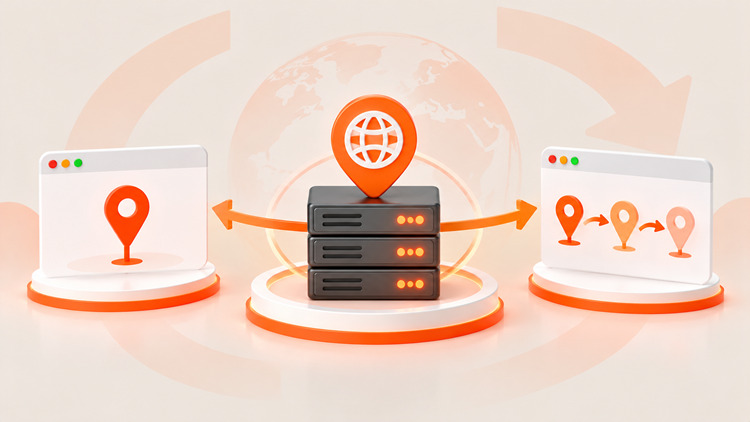
Sticky and rotating proxies are not two separate products. They are two session modes drawn from the same proxy pool. A sticky session keeps one exit IP across many requests. A rotating session assigns a new IP for each request.
The Backconnect Gateway Architecture
Your scraper does not connect to millions of devices one by one. Your traffic goes through a backconnect proxy gateway. You send every request to one entry endpoint (for example, gateway.provider.com:8080). The gateway applies your session rules, then forwards the traffic through an exit node.
What Are Rotating Proxies and When Does the IP Change?
Rotating proxies change the IP on a per-request basis. Each GET or POST you send can leave through a different IP from the pool.
- 🔁 How it works: The gateway cycles through a large IP pool. Each request can appear to come from a different device and location.
- 🎯 Main use case: Spreading requests across many IPs reduces the chance of hitting per-IP limits (HTTP 429 Too Many Requests) or IP bans.
- 🌍 Key point: Rotation is not the same as geotargeting. You can still pick a country or city. The pool simply rotates through IPs in that region.
What Are Sticky Proxies and How Do They Hold a Session?
Sticky proxies keep the IP the gateway assigned for a set time window. Common windows range from 1 minute up to 60 minutes, and the maximum depends on your provider.
- 🔌 Port-based control: Some providers use different ports for different behavior. For example, one port may rotate per request, while another keeps one IP for 10 minutes.
- 🏷️ Session-ID control: Some providers let you add a session string to your proxy username (for example,
username-session-abc123). While you reuse the same string, the gateway keeps routing you through the same exit IP. - 🛒 Main use case: A sudden IP change mid-task can end a login, empty a cart or trigger a security check. Sticky sessions keep the connection steady until the task finishes.
- ⏳ Key point: When the sticky window ends, the IP goes back to the pool. A static proxy is different. It gives you a fixed IP that does not expire while you keep the plan.
The table below compares the three proxy types side by side.
📊 Sticky vs Rotating vs Static Proxies: Clearing Up the Confusion
These three formats are easy to mix up. Knowing the difference helps you avoid technical errors and billing surprises.
| Feature | Rotating Proxy | Sticky Proxy | Static Residential (ISP) Proxy |
|---|---|---|---|
| IP change frequency | Every request (default) | After a set timer (for example 1–60 min), or if the exit node goes offline | Fixed. It does not change. |
| Session persistence | None by default | Temporary. Holds for multi-step forms and carts. | Permanent. Suited to long-term accounts. |
| IP source | Residential, datacenter or mobile pool | Residential, datacenter or mobile pool | Hosted in a datacenter but registered under an ISP, so it looks residential |
| Typical billing | Often by bandwidth (per GB) | Often by bandwidth (per GB) | Often a flat fee per IP per month |
| Main benefit | Spreads requests across many IPs | Keeps a natural session flow | Consistent location and identity over time |
| Main drawback | Breaks logins and multi-step forms | The IP can change early if the exit device goes offline | Smaller pool and higher cost per IP |
Billing models vary by provider, so always check the plan details before you buy.
Now let us look at when to use each mode in real projects.
🧭 When to Use Sticky vs Rotating Proxies
The choice depends on one question. Does your workflow need session continuity, or does it need IP diversity at high volume?
Best Use Cases for Rotating Proxies
- 🕸️ Large-scale web scraping: Collecting public product listings, news archives or real estate data across many pages.
- 🔎 SERP and SEO rank tracking: Checking search results at scale without hammering one IP.
- 💸 Price intelligence: Monitoring flight, hotel and retail prices across markets.
Why Rotating Proxies Fit Here
Rotating proxies scatter your requests across many IPs. Per-IP rate limits become much harder to trigger. Note that this does not make you invisible. Sites can still react to browser fingerprints, headers and request patterns.
Best Use Cases for Sticky Session Proxies
- 🛍️ Multi-step checkout flows: Product selection, cart, shipping details and payment. A mid-flow IP change can clear the cart or trigger fraud checks.
- 🔐 Scraping behind a login: The IP should stay the same from the login request through later page views.
- 📝 Multi-page forms: Long forms often tie progress and tokens to one session.
- 👤 Managing social accounts you own or are authorized to manage: A steady IP during a session looks more natural than constant switching.
Why Sticky Proxies Fit Here
Sticky proxies keep a natural session flow. Your cookies stay tied to one IP, which lowers the chance of challenges caused by sudden IP jumps.
🚀 Flexible Session Control with UtaProxy
Need both modes in one place? UtaProxy Rotating Residential Proxies, Rotating Datacenter Proxies and Rotating Mobile Proxies give you access to over 100 million+ IPs worldwide. Switch between per-request rotation and sticky sessions of up to 60 minutes right from your dashboard. ⚙️
Scenario Decision Guide
Use this table to match your task to a proxy mode.
| Use case | Recommended mode | Why |
|---|---|---|
| Scraping public e-commerce product pages | Rotating proxy | High request volume on public pages benefits from IP rotation. |
| Automated multi-page form submission | Sticky proxy (10–30 min) | Keeps form progress and session tokens on one IP. |
| Managing an Amazon Seller account | Static residential proxy | A fixed, dedicated IP gives a consistent login location. |
| Localized SERP scraping | Rotating proxy | Rotates IPs per request while keeping country or city targeting. |
| Checkout on a limited retail release | Sticky proxy (5–15 min) | Keeps session cookies from queue entry to checkout. |
| Mobile-app or mobile-site data checks | Rotating mobile proxy | Mobile carrier IPs match how real mobile users connect. |
| Fast, high-volume jobs on tolerant targets | Rotating datacenter proxy | Datacenter IPs are fast and cost-effective for less strict sites. |
Always follow each site's terms of service and applicable laws. Proxies are a tool, not a license to ignore a platform's rules. ⚖️
Next, a simple framework for making the final call.
✅ How to Choose: A Practical Decision Framework
A common question on Reddit's web scraping community sums up the dilemma. A newcomer asks whether high-quality sticky residential proxies beat ordinary rotating ones for scraping the same sites every day over a long period.
Short answer: If you scrape public pages and do not log in, rotating residential proxies are usually the better fit. A new IP on each request spreads your footprint across a large pool. That makes per-IP rate limiting less likely over time. Sticky proxies only matter when your workflow needs a login, a live cart or a multi-step form.
Use these two rules to decide.
Rule 1: Do You Need to Keep Cookies or a Login State?
- ❌ No (public pages): Choose rotating proxies for maximum IP diversity.
- ✔️ Yes (multi-step tasks): Choose sticky proxies and set the session length to match the task, often 10 to 30 minutes.
Rule 2: Are You Protecting a Long-Term Business Account?
For high-value accounts such as Amazon Seller Central, TikTok Shop or Facebook Ads Manager, sticky proxies are usually not the best choice. A sticky IP still changes when the timer ends. Frequent IP and location changes on a sensitive account can trigger security verification. For long-term accounts, use static residential proxies for a consistent location around the clock. 🔒
💡 Pro Tip: Switch Session Modes in Seconds
Not sure which mode your scraper needs? UtaProxy lets you test both. Use per-request rotation for broad collection and sticky sessions of up to 60 minutes for logins and checkouts. Start with rotating residential proxies for the most flexible setup. 🎛️
Best Practices for Sticky and Rotating Proxies
- 🍪 Bind cookies to the sticky IP: Store session cookies together with the session ID that produced them. This avoids authentication mismatches.
- 🚨 Rotate on error signals: Request a new session when you see 403, 429 or a CAPTCHA. This avoids needless IP switches.
- ⏱️ Match the timer to the task: Set the sticky window slightly longer than your longest workflow.
- 🧪 Test on a small batch first: Check success rates before you scale up.
🏁 Final Verdict: Match the Session Type to Your Workflow
Match the session behavior to the job. That is the whole decision.
- 🔄 Choose rotating proxies for public data at scale, such as listings, search results and market research. Start with rotating residential for trust, rotating datacenter for speed, or rotating mobile for mobile-first targets.
- 📌 Choose sticky proxies for multi-step checkouts, multi-page forms and scraping behind logins.
- 🔒 Choose static proxies for long-term assets such as ad accounts and online storefronts that need one permanent IP.
Ready to build a stable scraping pipeline? 🚀 Explore UtaProxy and set up rotating or sticky endpoints in minutes.
Daniel Carter
Proxy & Web Data Specialist
Daniel Carter is a Proxy & Web Data Specialist at UtaProxy, focusing on proxy technology, web data collection, and online infrastructure. He writes practical guides and in-depth insights to help businesses understand proxy solutions, choose the right proxy type, and build more reliable data workflows.
You May Also Be Interested
What Is a Proxy Server? How It Works, Types & Uses (2026 Guide)
Confused about proxy servers? See exactly how they work, the 4 main types, and when to use one over a VPN — explained simply, with real use cases.

Rotating Proxies Explained: A Complete Guide for Scraping, SEO & Automation
Learn what a rotating proxy is, how IP rotation works, the 4 main types, real use cases & setup steps. Stop IP bans and scale your scraping.